
 |
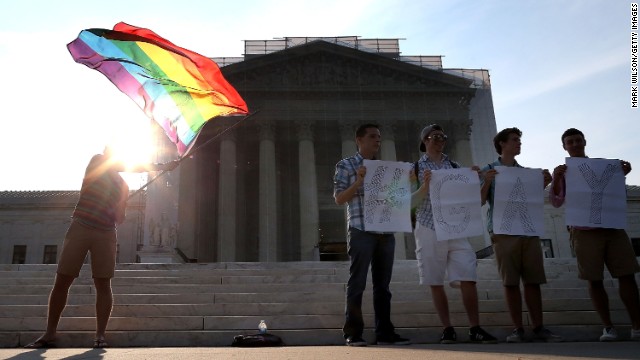
| Gay rights demonstrators outside the Supreme Court today. |
Today, the
Supreme Court ruled
that supporters of Proposition 8 lacked standing in the caseHollingsworth v. Perry, a decision which
will eventually lead to the State of California recognizing same-sex marriage. Additionally, the court decided in Windsor v. United States that the federal government must recognize all lawful marriages between same-sex couples, thus overturning key parts of the Defense of Marriage Act.
Opponents
of the decisions argued that the government should only recognize marriages
between a man and a woman. Other opponents felt the ruling in Hollingsworth did not go far
enough and argued all states must recognize same sex marriage. However, both
sides argued the government should recognize marriages in some form. They are
both wrong – government’s sole role in this area should be enforcing contracts
between the involved parties. Deciding what is and is not “marriage” should be
left to religious institutions and the consciences of individuals.
Under
marriage privatization, the government would not issue marriage licenses to any
couples, gay or straight. Instead, the highest recognition they could issue
would be a domestic union, or some other similar term. This would carry all the
benefits of marriage except the name. For instance, if one spouse was seriously
ill, the other would serve as medical proxy. If one spouse died, the other
could inherit the estate tax-free (the merit of inheritance taxes in the first
place is beyond the scope of this article.)
 |
| It should be the role of religious institutions and individual conscience to define "marriage". |
If a couple wanted a marriage for religious or
personal reasons, they could go to a church or other religious institutions.
These institutions could choose whether they wish to perform same-sex marriages
in accordance with the teachings of their religion. These marriages would be
purely ceremonial and carry no legal meaning.
Interfaith or non-religious couples
who want a marriage could get one too. While only justices of the peace,
judges, and a select few other groups can perform secular marriages today,
anyone would be able to officiate such a ceremony under marriage privatization,
provided all involved parties consented. For instance, a mutual friend could be
chosen to officiate if the couple desired.
At the end of government-sanctioned
marriage ceremonies, the minister, judge, or other official says “by the power
vested in my by the State of Connecticut, I now pronounce you husband and
wife.” Under marriage privatization, however, the official would not need any
government-granted power or authorization since only the domestic union
contract has legal meaning. How exactly the statement is phrased would be up to
the couple, but would probably resemble “By the power vested in me by this
couple….” After all, it is the couple, not the state, who is giving this person
permission to perform the ceremony. Marriage would be a private issue, not a
government one.
 |
| A polygamous family. It should not be up to the government to decide for everyone whether this is "natural" or not. |
Of course, up until this point, we
have been talking about “couples.” There is no reason why government-issued
domestic unions should be limited to two people. Although many people consider
polygamy to be immoral, families who do feel it is moral should be able to
practice it and have the same rights as everyone else. Creating the domestic
union contract would be somewhat more complicated with more than one spouse.
For instance, a husband would have to designate one wife as his medical proxy.
There are multiple other benefits which could only be used by one person.
However, as the domestic union is just a contract, this could be easily
remedied. For instance, a man with two wives could designate one as the medical
proxy and the other as the executor of his estate if he dies.
As with same-sex marriages, any
religious institution would be able to decide whether or not to perform
polygamous marriages. For instance, at one point the Church of Latter Day
Saints, better known as Mormonism, recognized polygamy,
although they no longer do so. Again, no religious institution would have to
officiate a “marriage” that they considered sinful or did not recognize. If a
polygamous family could find no religious institutions willing to perform their
marriage, they could choose the secular option, and anyone who was willing to
do so could perform the ceremony with the family’s consent.
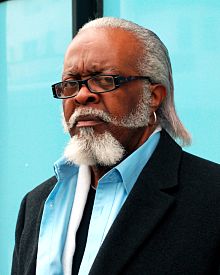 |
| Jimmy McMillan, who spoke in favor of person-shoe marriage at CPAC in 2011. |
During the 2011 Conservative
Political Action Conference (CPAC), Jimmy McMillan vowed
to personally perform marriages between a person and a shoe if the person
wanted him to.) In light of McMillan’s comments elsewhere at the event, he was
probably not being serious – other lines include “They asked me, ‘Mr. McMillan, what are you going to do about
abortion?’ I’m hungry now; I want a hamburger with cheese.”
However, man-shoe marriage does
raise some interesting questions for libertarians. A shoe is not a person, so
it clearly cannot enter into a domestic union contract. Even if the contract
somehow did get signed, the shoe would be unable to perform most of the
responsibilities, such as making decisions as a medical proxy. But should
ceremonial marriages between a person and a shoe be allowed?
On one hand, the shoe cannot
consent to entering into a marriage. On the other hand, the shoe is property,
and does not have to consent to anything. Therefore, (assuming someone like
McMillan is willing to officiate this ceremony) the same laws would apply to
marrying a shoe as to using property for any other reason. If a person owns a
shoe, marrying it falls under property rights. A responsible official would
require the person to prove ownership of the shoe before agreeing to do the
ceremony. Of course, if the person does not own the shoe, he would require
consent from the owner, just as he would require consent of the owner to do
anything else with the shoe. Although man-shoe marriage may seem completely
ridiculous, there is no reason for libertarians to prevent it, assuming all
involved parties consent.
 |
| While it might seem unusual for this shoe's owner to marry it, there is no reason for the government to prevent it. |
However, in this case there would
be no legal benefits due to the shoe’s inability to enter into a
contract. In
my opinion, that person would be better off finding a person to marry. But it
would be wrong to force my definition of marriage, whether that means only
heterosexual couples, all couples but nobody else, any number of human beings,
or the “anything at all” definition that would include human-shoe marriages, on
anyone else. The definition of marriage
should be left to religious institutions and individuals, and the government’s
sole role should be to enforce the contracts.

